
Last November, we issued a newsletter discussing world-wide supply and
demand of rare earth metals, the seventeen not-so-rare elements
commonly used in production of hybrid cars, electronic devices like cell
phones, wind turbines and modern weaponry. At the time, we noted
China’s dominant position in the rare earth supply chain and the country’s
expanded reserves and restrictive export policies. At issue is that China
holds in reserve about 50{41f8e085fc68038a2da2699f98ad8aea8b7e87e25f742017f6f76a0b55118d3c} and produces 95{41f8e085fc68038a2da2699f98ad8aea8b7e87e25f742017f6f76a0b55118d3c} of the world’s supply
(source: US Geological Survey). Yet, in an era of explosive demand, China
has controlled and limited exports, releasing less than half the rare earth
metals it did just 5 years ago.
Last month, it was these very export restrictions that came under fire as
the US, European Union and Japan filed a complaint with the World Trade
Organization demanding that China face sanctions should its policies
continue. The complaint alleges that by deliberately creating a scarcity of
rare earths, manufacturing and production from other countries are forced
into China. This would be in violation of the WTO General Agreement on
Tariffs and Trade of 1947 that states a member country cannot impose
export restrictions limiting world supply without also limiting domestic
supply. It is alleged that China is infusing domestic supply, keeping prices
low while at the same time limiting its exports and global supply.
In a White House press conference, President Obama stated, “We want
our companies building those products right here in America. But to do
that, American manufacturers need to have access to rare earth materials
which China supplies – Our competitors should be on notice: you will not
get away with skirting the rules.”
Not surprisingly, China rejects the allegations, stating that its trade
practices fall within WTO rules regarding the protection of natural
resources, and claims its policies are not intended to produce restraint of
trade. A decision will be rendered at the end of this year.
As often happens in a free market economy, high prices yield innovation,
which we are experiencing in the case of rare earths. The world is growing
its mining and production of rare earth metals with approximately 400+
projects under development by some 259 different companies in 36
different countries (source: Technology Metals Research). Increased
production is expected in Malaysia, Russia, Brazil and India as well as the
controversial Mountain Pass mine in California. In an ironic twist, this US
mine purchased by Colorado-based Molycorp, Inc. has come under criticism for selling much of its rare earth metals to China. In addition, recycling remains strong and alternat ives to rare earths are regularly uncovered. Early this year, Toyota announced it has engineered rare earth metals out of its hybrid and electric vehicles.
As a result, the prices of rare earth metals have been volatile, rising to
record highs in the first six month’s of 2011, then dropping dramatically as
the year ended. Rare earths such as cerium oxide, often used as a
polishing catalyst for colored glass and flat screen tv screens, averaged a
high of $138.29 per kg in the second quarter of last year, falling to $45 per
kg. Lanthanum oxide, used in lighting, laptop batteries, camera lenses and
hybrid car batteries closed the year at about $52 per kg, down from a high
of $135.02 per kg.
Still, as long as our cell phones require rare earth metals to vibrate,
demand will remain high. We expect prices will continue to drop as mine
production ramps up and more alternatives are uncovered. New production
and innovation take time, however, and so we may continue to see
volatility in the rare earth market until the WTO’s decision is rendered.
At Admiral, it is crucial to our business and to our customers, that we
monitor the global metals marketplace, including trends in related
industries. It’s one more way we deliver superior service to you, our valued
customers.
Brass and bronze are two of the most widely used copper alloys in precision manufacturing — and while they're often mentioned in the same breath, they perform very differently in the field. Choosing the right alloy for a given application isn't just about cost or availability; it's about matching the material's properties to the demands of the job.
This guide covers the key differences between brass and bronze, highlights the grades we rely on most at Admiral Metals — including C360's industry-leading machinability, C954's outstanding corrosion resistance, and the growing shift from C360 to C2745 for lead-free applications — and gives you a practical framework for making the right call.
The Fundamental Difference
Both are copper alloys, but the alloying elements define everything:
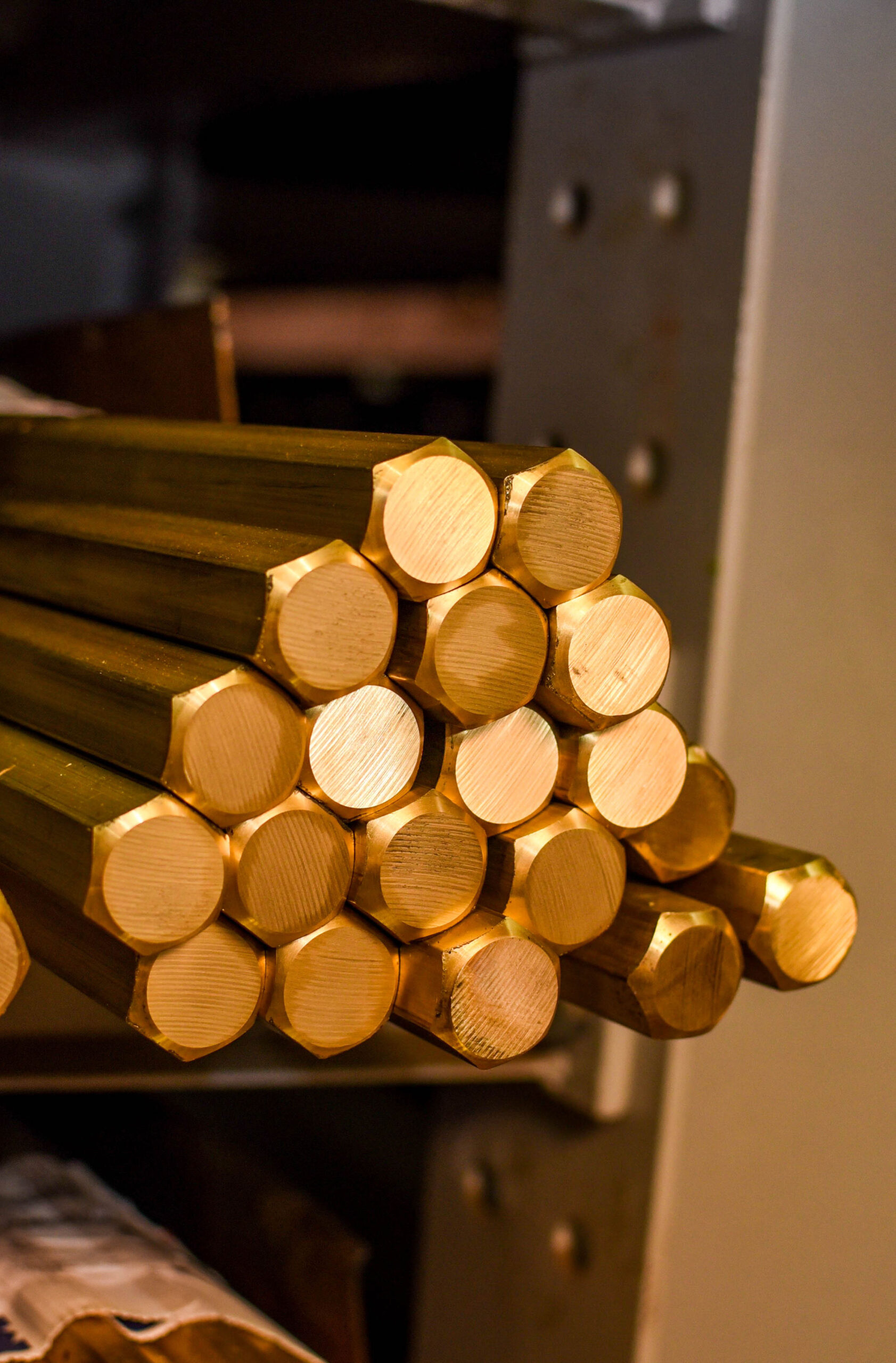
Brass
Bright golden appearance, excellent machinability, and strong corrosion resistance in everyday environments. The go-to choice for high-volume precision machining.
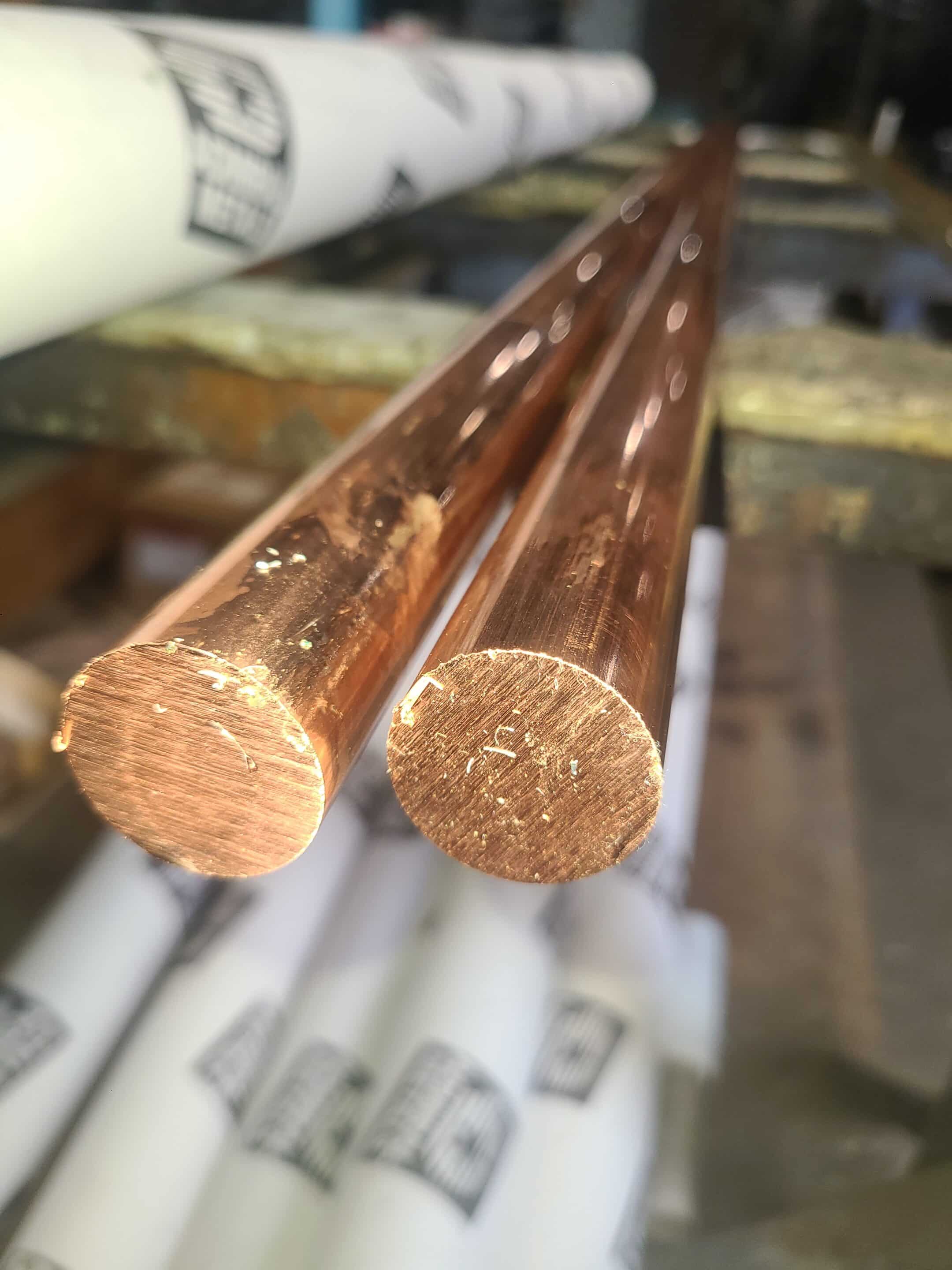
Bronze
Harder, stronger, and superior in harsh or submerged environments. The specialist alloy for marine, industrial, and heavy-load applications.
Zinc (brass) favors cost, machinability, and electrical conductivity. Tin, aluminum, or silicon (bronze) favors strength, wear resistance, and corrosion performance under demanding conditions.
Key Property Comparison
| Property | Brass | Bronze |
|---|---|---|
| Machinability | ||
| Corrosion Resistance | ||
| Hardness / Wear | ||
| Material Cost | ||
| RoHS / Lead-Free | C360: contains lead · C2745: fully compliant | C954: compliant |
Brass Grades: What You Need to Know
C360 — Free-Cutting Brass: The Machinability Benchmark
C360 — Alloy 360 / Free-Cutting Brass
- Machinability rated at ~100% — the universal benchmark against which all other copper alloys are measured
- Contains ~3% lead, which acts as a built-in chip-breaker and internal lubricant during cutting operations
- Produces short, manageable chips — critical for screw machines and high-speed CNC turning centers
- Dramatically extends tool life and enables faster cycle times versus other copper alloys
- Delivers excellent surface finish with minimal secondary operations required
- Ideal for fittings, valves, fasteners, gears, and general-purpose machined components
- Limitation: Not RoHS compliant — restricted in potable water plumbing, EU-exported products, and medical applications
The lead particles in C360 don't dissolve into the copper matrix — they remain as tiny dispersed inclusions that act as a chip-breaker and internal lubricant at the cutting edge. The result: short, manageable chips instead of the long stringy swarf that plagues other alloys, dramatically reduced tool wear, faster cycle times, and a superior surface finish right off the machine. For high-volume screw machine work or CNC turning, no other copper alloy delivers this combination of speed, finish quality, and cost efficiency.
C2745 — Lead-Free Eco Brass: The Modern Alternative
The traditional choice
~3% lead content · Machinability ~100% · Not RoHS or NSF 61 compliant · Restricted in potable water and EU applications
The lead-free standard
<0.09% lead · Machinability ~70–80% of C360 · Fully RoHS, NSF 61 & California AB 1953 compliant · Drop-in replacement for most machined parts
As regulations around lead in plumbing and potable water systems have tightened — particularly under NSF/ANSI 61, the EU's RoHS directive, and California's AB 1953 (Prop 65 "Lead-Free" standard) — the industry has been steadily migrating away from C360 for these applications. C2745 is the primary engineered replacement: it retains excellent machinability (~70–80% of C360), fits the same stock forms and tolerances, and requires no significant design changes in most cases.
Other Key Brass Grades
C464
- Tin addition significantly improves seawater corrosion resistance over standard brass
- Common in marine hardware, propeller shafts, and condenser tubes
- Good combination of strength and formability
C260
- Exceptional cold-working and deep-draw capability
- Used for ammunition casings, radiator cores, springs, and stampings
- Good corrosion resistance; moderate machinability
Bronze Grades: Strength Where It Counts
C954 — Aluminum Bronze: The Corrosion Resistance Leader
C954 — Alloy 954 / Aluminum Bronze
- Outstanding corrosion resistance — resists seawater, mild acids, and high-temperature oxidation
- Aluminum content (~9–11%) forms a tenacious, self-healing oxide layer similar in principle to stainless steel
- High tensile strength (~85 ksi) combined with excellent wear and erosion resistance
- Preferred for pump impellers, propellers, marine shafting, valves, and chemical plant components
- Inherently corrosion-resistant throughout its cross-section — not dependent on coatings or plating
- Lead-free and fully compliant with environmental regulations
- Well-suited for heavy structural and flow-exposed parts where coating integrity cannot be guaranteed
The aluminum content in C954 creates a dense, tightly adhering aluminum oxide surface layer that reforms instantly if the surface is scratched or abraded — providing robust, self-repairing protection in saltwater, mild acids, and oxidizing atmospheres. Unlike many alloys that rely on surface coatings for corrosion protection, C954 is corrosion-resistant throughout its entire cross-section. This makes it the material of choice for pump components, propeller hubs, marine shafting, and any application where coating integrity cannot be reliably maintained.
Other Key Bronze Grades
C932
- The workhorse bearing bronze — conformable, low friction, embeds contaminants
- Excellent for bushings, washers, and thrust bearings under moderate loads
- Available in oil-impregnated form for self-lubricating applications
C510 / C544
- Phosphorus addition increases hardness and significantly improves fatigue resistance
- Excellent for springs, electrical contacts, and fine wire mesh
- Good corrosion resistance in both fresh and salt water
C651 / C655
- Outstanding weldability — preferred for architectural and artistic fabrication
- Good strength and corrosion resistance
- Used in marine fasteners, bolts, and sculpture
C863
- Very high strength — among the strongest of all copper alloys
- Used for heavy-duty gears, wear plates, and structural hardware
- Good resistance to dezincification in seawater
When to Use Each: A Practical Guide
Choose Brass When…
- High-volume precision machining is the priority (C360 or C2745)
- Electrical or thermal conductivity matters for the design
- Aesthetic / decorative finish is important (warm golden color)
- Cost is a primary constraint on the project
- Mild corrosion environments — air, fresh water, indoor service
- Lead-free compliance is required → specify C2745 or C464
- Plumbing fittings, HVAC components, instrumentation
- Locks, gears, ammunition casings, musical instruments
Choose Bronze When…
- Marine or submerged saltwater exposure is a factor (C954, C464)
- High wear, bearing, or bushing performance is required (C932, C954)
- Elevated temperature or chemical plant service conditions apply
- Heavy structural parts require high tensile strength
- Pump impellers, propellers, shafts, valves in aggressive media
- Springs and electrical contacts needing fatigue resistance (C510)
- Welded assemblies and architectural or artistic work (C655)
- Inherent corrosion resistance is needed throughout the cross-section
Quick Grade Reference
The Bottom Line
Brass and bronze aren't interchangeable — they're complementary. Brass wins on machinability, cost, and everyday corrosion resistance, making it the default choice for precision machined parts in benign environments. Bronze wins in demanding conditions: marine exposure, heavy loads, bearing surfaces, and anywhere a coating simply can't be relied upon.
Within each family, grade selection matters just as much as alloy family. C360 remains the machining benchmark, but C2745 is becoming the responsible default for any application touching potable water or destined for regulated markets. And when corrosion or wear is the design driver, C954 aluminum bronze is in a class of its own among copper alloys.
Not sure which grade is right for your next job? Our team has been matching customers to the right material since 1950 — give us a call or request a quote online.
Ready to Order or Need a Recommendation?
Admiral Metals stocks a full range of brass and bronze alloys in rod, bar, tube, and plate — cut to your exact requirements.