
In the 2008 New Yorker article, “American Scrap,” John Seabrook discusses the history of the scrap metal industry: “The business is founded on a fundamental truth: almost all the metal that has ever existed in the world still exists.” Nonferrous metals, including aluminum, copper, lead, nickel, tin, zinc, and others, are among the few materials that do not degrade or lose their chemical or physical properties during the recycling process. As a result, nonferrous metals have the capacity to be recycled an infinite number of times. Of an estimated total of 700 million tons of aluminum produced in the world since commercial manufacturing began in the 1880s, about 75{41f8e085fc68038a2da2699f98ad8aea8b7e87e25f742017f6f76a0b55118d3c} is still in productive use as secondary raw material. Ferrous metals are highly recyclable as well. In 2010, US industrial and manufacturing companies processed 74 million metric tons of ferrous scrap which equals 55{41f8e085fc68038a2da2699f98ad8aea8b7e87e25f742017f6f76a0b55118d3c} of all domestically processed materials. If you are processing and machining metals in your business, perhaps without even realizing it, you are already part of one of the “Greenest” business processes: the recycling of metal.The economics of our industry is such that metal production and manufacturing has historically been at the forefront of recycling and as such, has had a significant effect on both the environment and the economy. According to Forbes in 2011, the economic impact of the scrap recycling industry has been widespread across the United States. “The industry supports more than 450,000 American jobs and generates $10.3 billion in revenue for federal, state, and local governments. In fact, the total economic activity brought about by scrap recycling in the United States in 2011 is more than 90.6 billion, making the industry close to the size of both the nation’s forestry and fishing industries combined.” The benefits to the environment are far ranging, including a reduction in energy use, greenhouse gas emissions, landfill waste, and the exploitation of natural resources that accompanies mining.As an industry, we are leaders in recycling, but can we extend our “green” efforts even further? Can we do more than the recycling of metals that is part of our daily operations? Of course, in ways both large and small, most of us can do more, Admiral Metals included. The benefits are more than environmental; it makes good economic sense as well. Depending on individual usage, each year, a company might save hundreds of dollars by reducing paper use and several thousand dollars in lighting or waste disposal costs by adopting greener practices.
The most effective sustainability efforts require a whole-company approach, according to the New York Times article, “How to Make Your Business Greener (and Save Money)”. Shifting to a greener model takes thought, planning, and buy-in from all levels within an organization. Often, it starts with an advocate; a person to act as the steward of the program and be in charge of creating initiatives, communications, implementation, measurement and stimulating interest and support within the organization so that “green” becomes embedded in the culture.Here are a few simple suggestions for how we all might try to be “Greener”:Take Inventory: Look at the places where you spend the most money. Common areas to consider are lighting, powering your equipment, heating, air-conditioning, transportation, packaging, and water use. Call your local power company for a free energy audit. Using higher technology lighting can save thousands in electric bills. At Admiral, our last energy audit yielded lighting changes that give us two times the lumens for one third the cost.Do the Easy Stuff: Find tasks that can be accomplished almost immediately and then build from there with actions that cost nothing or very little to apply. A few examples include shutting down electronics at night, turning off overhead lights during daylight hours, opening windows to get natural ventilation instead of running the air conditioning, and bringing plastic bottles and aluminum cans from your office to a recycling facility where they can be recycled and reused in a responsible manner. Simple things like turning off lights can make a difference and save you money.
Track and Report: As with any business initiative, review your results periodically. Showing positive financial gains by measuring energy, waste, and water use, will keep the process on track as well as keep employees motivated.
Build on Your Progress: After adopting a green company or greater sustainability policy, build on your success no matter how small. Be honest and clear about the steps you’ve taken to improve performance, and acknowledge that it is all part of an ongoing process that takes time. Your employees and customers will recognize the sincerity of your efforts.
At Admiral Metals, we’re starting the process of trying to be a greener and more environmentally efficient company by looking for ways to reduce scrap, saving fuel by optimizing our trucking routes and encouraging more fuel efficient vehicles for our sales team. We’re hoping to see both an economic and an environmental impact by this effort.
We’d like to hear from you. What steps are you taking to recycle more and reduce your company’s carbon footprint? Let us know if we can reprint them (anonymously or not) so that we can share in both the environmental and economic benefits of running out businesses in the “green.”
Wishing you the very best in business,

Brass and bronze are two of the most widely used copper alloys in precision manufacturing — and while they're often mentioned in the same breath, they perform very differently in the field. Choosing the right alloy for a given application isn't just about cost or availability; it's about matching the material's properties to the demands of the job.
This guide covers the key differences between brass and bronze, highlights the grades we rely on most at Admiral Metals — including C360's industry-leading machinability, C954's outstanding corrosion resistance, and the growing shift from C360 to C2745 for lead-free applications — and gives you a practical framework for making the right call.
The Fundamental Difference
Both are copper alloys, but the alloying elements define everything:
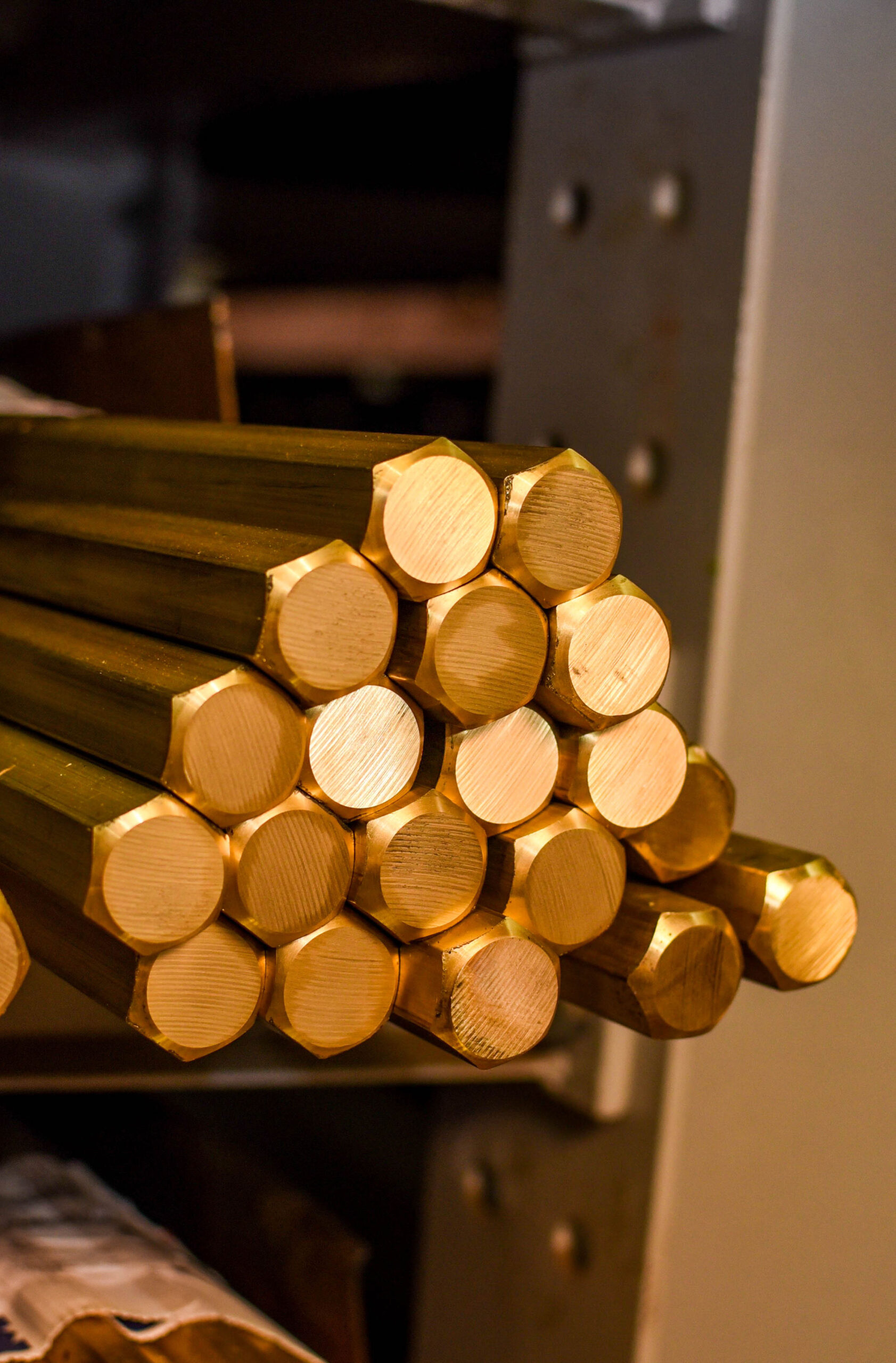
Brass
Bright golden appearance, excellent machinability, and strong corrosion resistance in everyday environments. The go-to choice for high-volume precision machining.
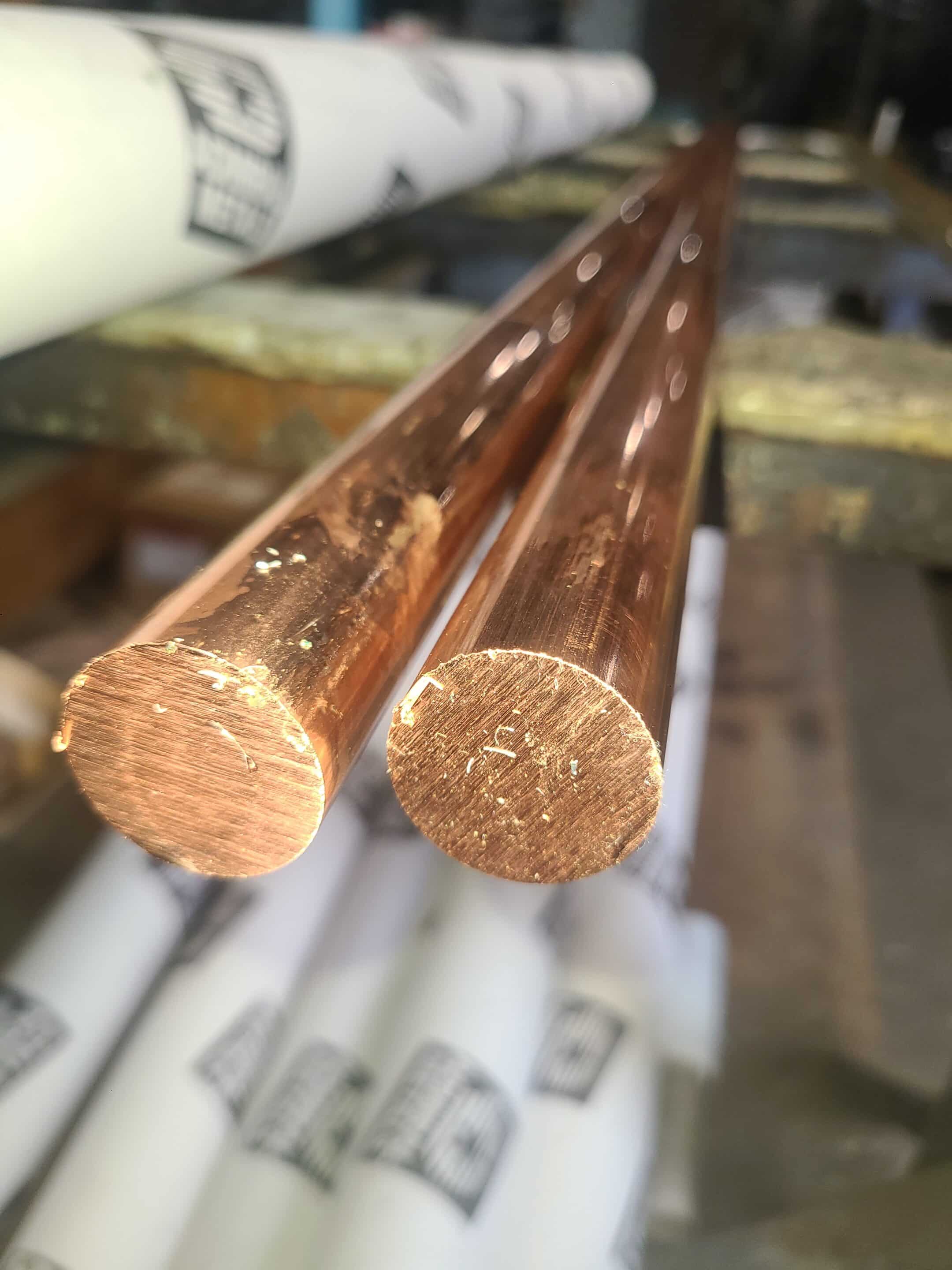
Bronze
Harder, stronger, and superior in harsh or submerged environments. The specialist alloy for marine, industrial, and heavy-load applications.
Zinc (brass) favors cost, machinability, and electrical conductivity. Tin, aluminum, or silicon (bronze) favors strength, wear resistance, and corrosion performance under demanding conditions.
Key Property Comparison
| Property | Brass | Bronze |
|---|---|---|
| Machinability | ||
| Corrosion Resistance | ||
| Hardness / Wear | ||
| Material Cost | ||
| RoHS / Lead-Free | C360: contains lead · C2745: fully compliant | C954: compliant |
Brass Grades: What You Need to Know
C360 — Free-Cutting Brass: The Machinability Benchmark
C360 — Alloy 360 / Free-Cutting Brass
- Machinability rated at ~100% — the universal benchmark against which all other copper alloys are measured
- Contains ~3% lead, which acts as a built-in chip-breaker and internal lubricant during cutting operations
- Produces short, manageable chips — critical for screw machines and high-speed CNC turning centers
- Dramatically extends tool life and enables faster cycle times versus other copper alloys
- Delivers excellent surface finish with minimal secondary operations required
- Ideal for fittings, valves, fasteners, gears, and general-purpose machined components
- Limitation: Not RoHS compliant — restricted in potable water plumbing, EU-exported products, and medical applications
The lead particles in C360 don't dissolve into the copper matrix — they remain as tiny dispersed inclusions that act as a chip-breaker and internal lubricant at the cutting edge. The result: short, manageable chips instead of the long stringy swarf that plagues other alloys, dramatically reduced tool wear, faster cycle times, and a superior surface finish right off the machine. For high-volume screw machine work or CNC turning, no other copper alloy delivers this combination of speed, finish quality, and cost efficiency.
C2745 — Lead-Free Eco Brass: The Modern Alternative
The traditional choice
~3% lead content · Machinability ~100% · Not RoHS or NSF 61 compliant · Restricted in potable water and EU applications
The lead-free standard
<0.09% lead · Machinability ~70–80% of C360 · Fully RoHS, NSF 61 & California AB 1953 compliant · Drop-in replacement for most machined parts
As regulations around lead in plumbing and potable water systems have tightened — particularly under NSF/ANSI 61, the EU's RoHS directive, and California's AB 1953 (Prop 65 "Lead-Free" standard) — the industry has been steadily migrating away from C360 for these applications. C2745 is the primary engineered replacement: it retains excellent machinability (~70–80% of C360), fits the same stock forms and tolerances, and requires no significant design changes in most cases.
Other Key Brass Grades
C464
- Tin addition significantly improves seawater corrosion resistance over standard brass
- Common in marine hardware, propeller shafts, and condenser tubes
- Good combination of strength and formability
C260
- Exceptional cold-working and deep-draw capability
- Used for ammunition casings, radiator cores, springs, and stampings
- Good corrosion resistance; moderate machinability
Bronze Grades: Strength Where It Counts
C954 — Aluminum Bronze: The Corrosion Resistance Leader
C954 — Alloy 954 / Aluminum Bronze
- Outstanding corrosion resistance — resists seawater, mild acids, and high-temperature oxidation
- Aluminum content (~9–11%) forms a tenacious, self-healing oxide layer similar in principle to stainless steel
- High tensile strength (~85 ksi) combined with excellent wear and erosion resistance
- Preferred for pump impellers, propellers, marine shafting, valves, and chemical plant components
- Inherently corrosion-resistant throughout its cross-section — not dependent on coatings or plating
- Lead-free and fully compliant with environmental regulations
- Well-suited for heavy structural and flow-exposed parts where coating integrity cannot be guaranteed
The aluminum content in C954 creates a dense, tightly adhering aluminum oxide surface layer that reforms instantly if the surface is scratched or abraded — providing robust, self-repairing protection in saltwater, mild acids, and oxidizing atmospheres. Unlike many alloys that rely on surface coatings for corrosion protection, C954 is corrosion-resistant throughout its entire cross-section. This makes it the material of choice for pump components, propeller hubs, marine shafting, and any application where coating integrity cannot be reliably maintained.
Other Key Bronze Grades
C932
- The workhorse bearing bronze — conformable, low friction, embeds contaminants
- Excellent for bushings, washers, and thrust bearings under moderate loads
- Available in oil-impregnated form for self-lubricating applications
C510 / C544
- Phosphorus addition increases hardness and significantly improves fatigue resistance
- Excellent for springs, electrical contacts, and fine wire mesh
- Good corrosion resistance in both fresh and salt water
C651 / C655
- Outstanding weldability — preferred for architectural and artistic fabrication
- Good strength and corrosion resistance
- Used in marine fasteners, bolts, and sculpture
C863
- Very high strength — among the strongest of all copper alloys
- Used for heavy-duty gears, wear plates, and structural hardware
- Good resistance to dezincification in seawater
When to Use Each: A Practical Guide
Choose Brass When…
- High-volume precision machining is the priority (C360 or C2745)
- Electrical or thermal conductivity matters for the design
- Aesthetic / decorative finish is important (warm golden color)
- Cost is a primary constraint on the project
- Mild corrosion environments — air, fresh water, indoor service
- Lead-free compliance is required → specify C2745 or C464
- Plumbing fittings, HVAC components, instrumentation
- Locks, gears, ammunition casings, musical instruments
Choose Bronze When…
- Marine or submerged saltwater exposure is a factor (C954, C464)
- High wear, bearing, or bushing performance is required (C932, C954)
- Elevated temperature or chemical plant service conditions apply
- Heavy structural parts require high tensile strength
- Pump impellers, propellers, shafts, valves in aggressive media
- Springs and electrical contacts needing fatigue resistance (C510)
- Welded assemblies and architectural or artistic work (C655)
- Inherent corrosion resistance is needed throughout the cross-section
Quick Grade Reference
The Bottom Line
Brass and bronze aren't interchangeable — they're complementary. Brass wins on machinability, cost, and everyday corrosion resistance, making it the default choice for precision machined parts in benign environments. Bronze wins in demanding conditions: marine exposure, heavy loads, bearing surfaces, and anywhere a coating simply can't be relied upon.
Within each family, grade selection matters just as much as alloy family. C360 remains the machining benchmark, but C2745 is becoming the responsible default for any application touching potable water or destined for regulated markets. And when corrosion or wear is the design driver, C954 aluminum bronze is in a class of its own among copper alloys.
Not sure which grade is right for your next job? Our team has been matching customers to the right material since 1950 — give us a call or request a quote online.
Ready to Order or Need a Recommendation?
Admiral Metals stocks a full range of brass and bronze alloys in rod, bar, tube, and plate — cut to your exact requirements.